
B. 1960, Agrigento. Lives and works in Agrigento.
The Holzwege Group
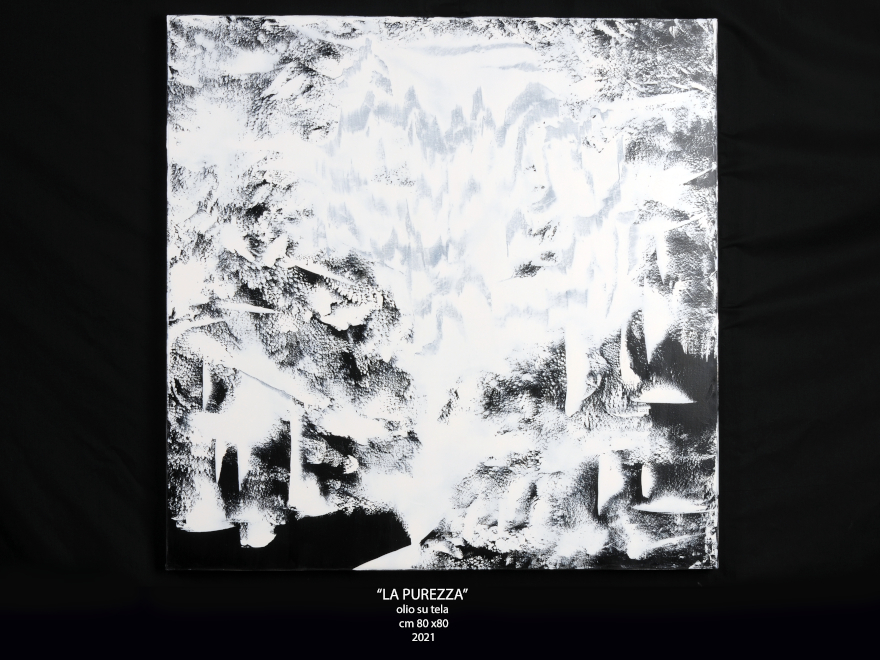
Cinzia Bulone has a multidisciplinary cultural background and is self-taught in painting. She began her artistic career in the late 1970s. In the 1990s she exhibited in solo and group shows in her homeland. Her independence and uncompromising love of freedom led her to accept a condition of isolation, which pushed her to seek a personal and contemporary pictorial language. Over the years, her style has undergone an almost complete transformation. Among her most recent exhibitions: a solo show in Palermo (2016); group exhibitions in various European cities (London, Paris, Berlin, Croatia) and internationally (Miami, Cuba), with Galleria Farini (Bologna); participation in Arte Padova and Arte Genova; group exhibitions in Italy (Milan, Venice, Bologna, Udine, Florence, Rome); invited participation in the Premio della Lupa (2019); solo exhibition in Treviso (Casa dei Carraresi, 2019); articles in Art Style Magazine (2018 and 2021); solo exhibition in Mantua (Casa del Mantegna, 2021); solo exhibition in Agrigento (Pietro Griffo Regional Archaeological Museum, 2023); solo exhibitions in Piacenza (Studio C, 2024–2025). Her current artistic expression is marked by a deliberate intention to conceal the concreteness and individual manifestation of life, while bringing to the surface the repercussions that such concreteness has on human existence—repercussions that sometimes accelerate, at other times hinder, the relentless search for a profound and hidden good dwelling within each individual: concealing the cause while highlighting its effects. In her pictorial research, the everyday determines and dictates the point of departure, or even the choice of the path leading to the inner universe, where it resonates like a distant yet revealing echo. It is an essential impulse in expressing the breath of the collective soul. Though we move as separate individuals in our uniqueness, we nonetheless flow through history as the people of an era. The titles of her works function as virtual keys, allowing contemporary readings of physical and metaphysical realities.
 Grenada Venice